

The great news for those investing in tequila: The industry isn’t just trending, it’s thriving. With skyrocketing demand, a shift toward premium products and deep cultural roots, it’s one of the most dynamic categories in the spirits world right now. Let’s take a look at some recent statistics.
Global Production & Growth
- Mexico produced over 650 million liters of tequila annually in recent years, and that number keeps climbing.
- The industry has more than doubled production since the early 2000s, driven largely by export demand.
- There are now 2,000+ registered tequila brands worldwide.
The U.S. Loves Tequila
- The United States is the largest consumer of tequila, importing over 80% of Mexico’s exports.
- Tequila is one of the most popular spirit category in the U.S., behind vodka.
- Premium tequila (100% agave) is the fastest-growing segment in the spirits industry.
- According to DISCUS, since 2002, tequila volumes have grown 180%, an average rate of 6.2% per year. In 2019, 20.1 million 9-liter cases were sold.
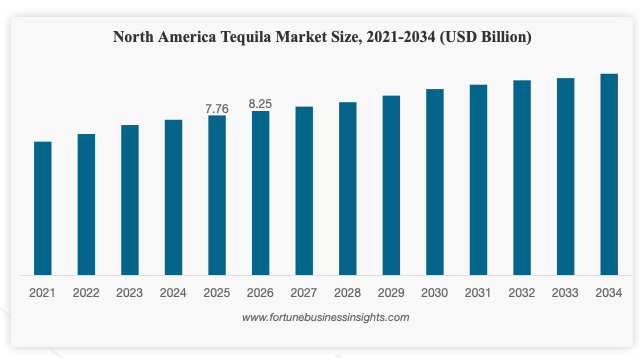
- According to Fortune Business Insights, the U.S. demand for tequila is projected to reach $7.44 billion by 2032, driven by evolving consumer preferences, strong cocktail culture, celebrity endorsements and rising demand for premium agave spirits.
Agave & Agriculture
- It takes 6-10 years for Blue Weber Agave to mature before harvest.
- Roughly 15 pounds of agave are needed to produce one liter of tequila.
- Millions of agave plants are harvested each year, making it one of Mexico’s most important agricultural products.
Types & Preferences of Tequila
- Blanco tequila accounts for the largest share of production globally.
- However, reposado, añejo and extra añejo tequilas are growing quickly as drinkers shift toward sipping spirits.
- The “premiumization” trend means consumers are spending more per bottle than ever before.
Economic Impact
- The industry supports tens of thousands of jobs in Jalisco and surrounding regions.
- Tequila exports generate billions of dollars annually for Mexico’s economy.
- The industry is regulated by the Consejo Regulador del Tequila (CRT), which ensures authenticity and quality standards.
- Every bottle must list a NOM number, identifying the distillery where it was made.